
Focus
Unmixed attention is prayer

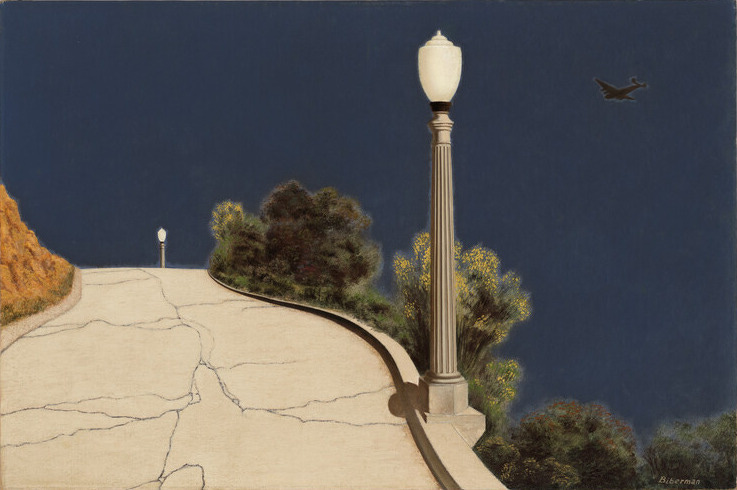
First, I’d love to invite you to KHORIKOS’s upcoming gala + concert, celebrating our 20th year as an ensemble. We’re singing some of the pieces that kicked off our relationships with a handful of great composers, whom I’ve since commissioned a bunch of new music from and made dear friends of. We’ll also singing one of my own from 2023, in which I spatter dramatic countermelody all over Byrd’s Lamentations.
Come for the wine and snacks, stay for the music that has made me want to keep doing this and doing this and doing this.
Also, if you happen to know anyone in The Recording Academy, I would appreciate if you could draw their attention to the fact that our latest album is under consideration for a Grammy in the Immersive Audio Album and Choral Performance categories. It’s good music, and the hard work of a lot of creative people. There, it’s done
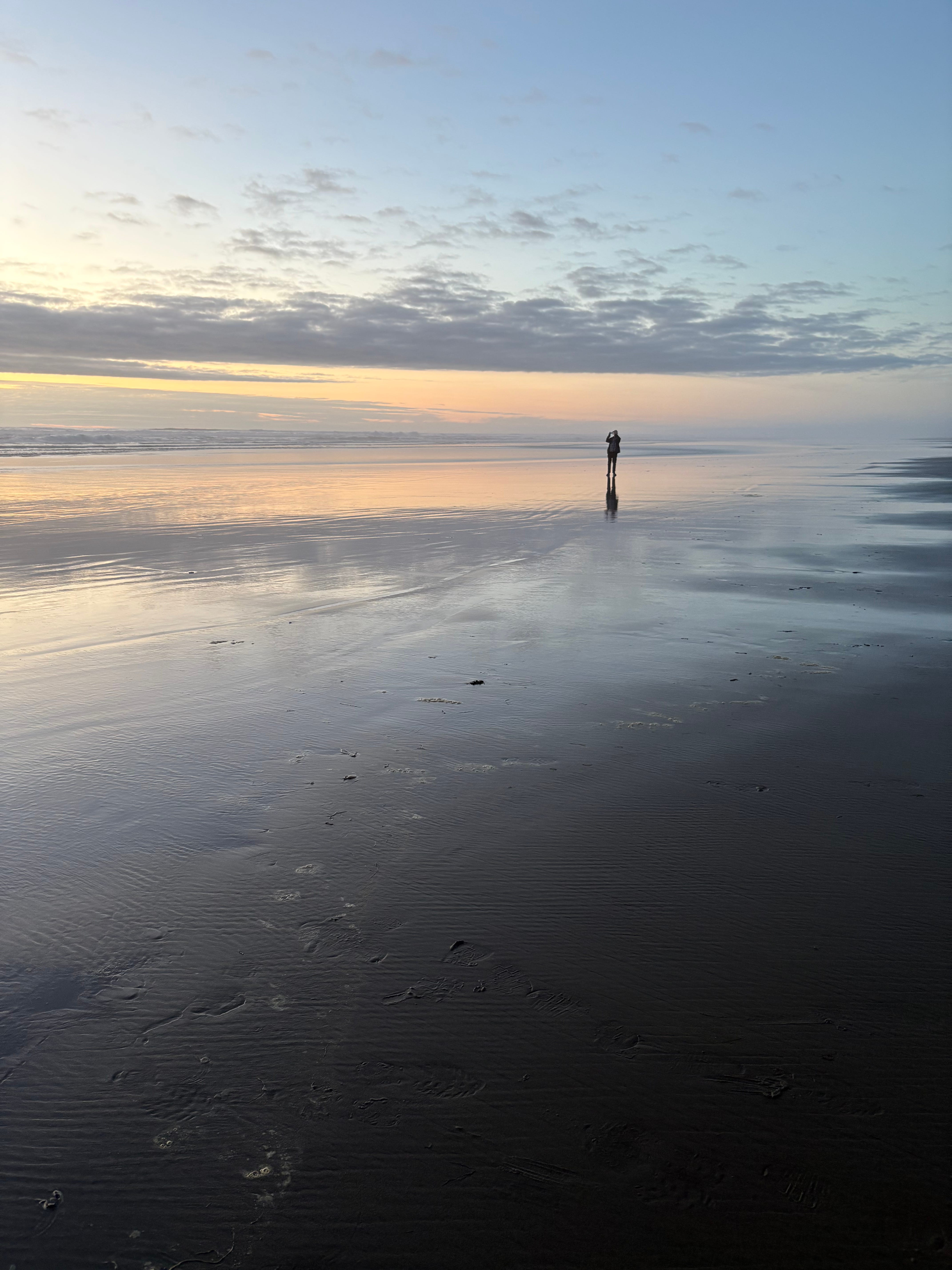
I recently spent a month on the Washington coast where I was gratefully attending the Willapa Bay artist-in-residency program. (I highly recommend applying if you’re into that.) A friend who had attended previously told me about frank: sonnets by Diane Seuss, who wrote part of that incredible collection at the same residency, looking out from the same shoreline:
Sometimes I can’t feel it, what some call
beauty. I can see it, I swear,
and later:
I can photograph it, I can name it
beautiful, but feel it, I don’t know that I am
feeling it, when I drown in it, maybe then.
It hit right in the writer’s block. Not as hard as I’d like, though, as the poem prophesied.
Now back in NYC, in rehearsal for our event on the 26th, I’m studying my friend Andrew Smith’s Nunc Dimittis and it hits again, clothed in “quia viderunt oculi mei salutare tuum”/“for my eyes have seen your salvation”
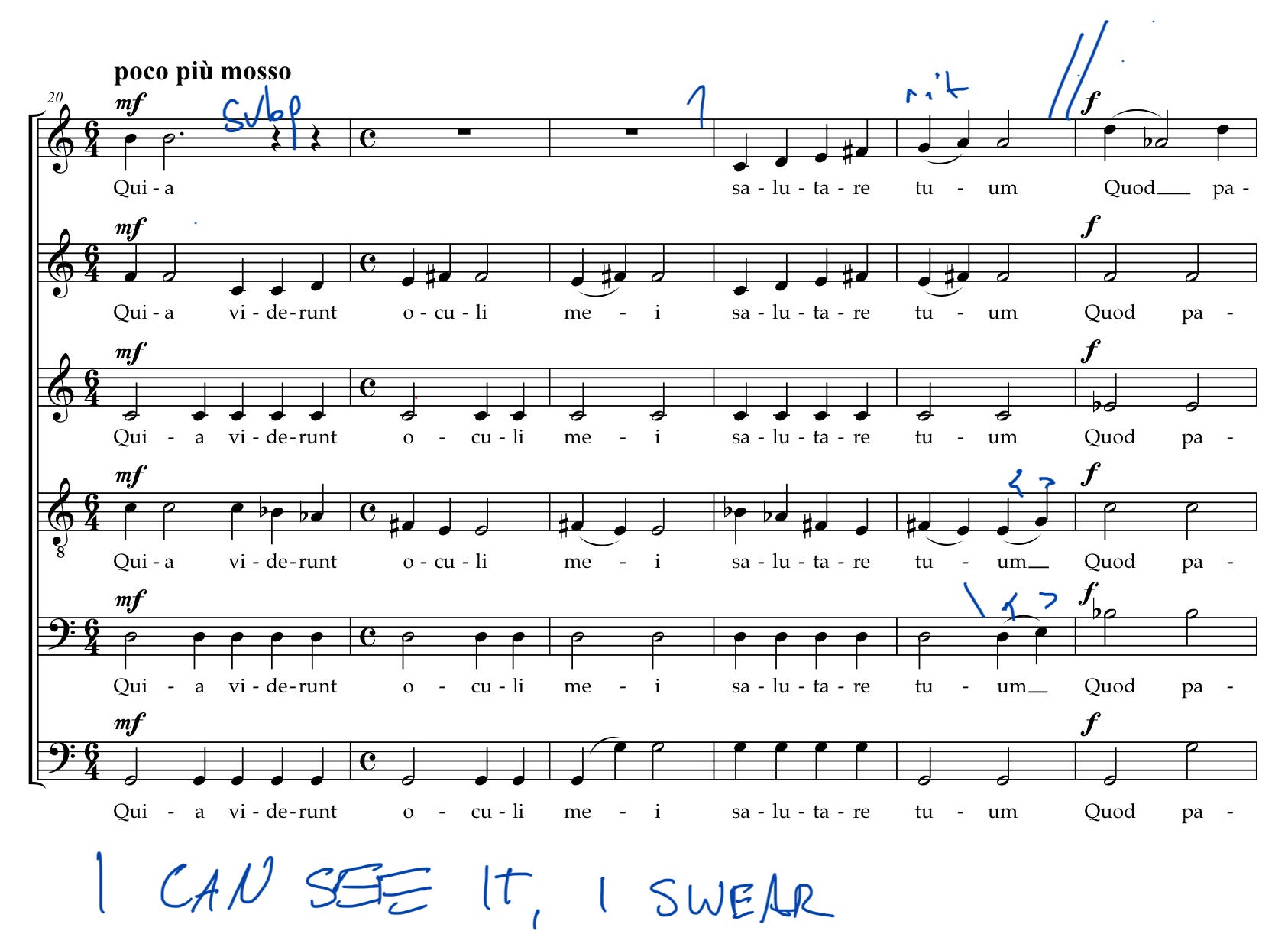
I swear I can, with music as the lens. But I often struggle to focus. I have trouble reliably tapping into it as a source of motivation, instead reaching for lower-hanging fruit. Sure, this is in part because this city is loud; life is loud. The signal gets buried.
I know I’m not alone, judging by friends with whom I text with about politics, in which *at best* we try to understand what’s going on for the sake of some vague and unfashionable hope that a solution will emerge through understanding; much more often though, it’s a sanity check that mostly affirms our held positions and doesn’t lead (directly, at least) to a meaningful challenge to our government’s greed, cowardice, cruelty, and the ripple effect of each on our social contracts. Solidarity’s crucial, for sure. But bearing a burden, or even sharing it, is only the first step toward really looking at it, addressing it.
As a response to this and other kinds of attention-suck, commanding myself to “focus” feels like a hollow scold. As much as I could use a kick in the pants I know the danger of flooding oneself with cortisol through self-flagellation. And I’m also wary of focus, because it can feel like putting on blinders. I’ve thought of focus as a closing-off, anathema to awareness, an act of shutting out breadth in exchange for depth. That’s dangerous, so I’d better be sure I’m focusing on the right thing! I want to serve that thing and I want that thing to serve. And if that thing is “art,” it has seemed that a looser state of “taking-in,” a lack of focus, is what serves it, and what it serves.
This framework has started to break down a bit. Diane again:
The sonnet, like poverty, teaches you what you can do
without
this is a lot so here are some bears
to help us bear it
Simone Weil, born an Alsatian Jew (there are not a ton of us!), wrote in France during the Nazi occupation. She spent her short life searching for a moral practice that everybody could subscribe to. Ultimately she called for a shift in our attention, proclaiming “absolutely unmixed attention is prayer.”
If we turn our mind toward the good, it is impossible that little by little the whole soul will not be attracted thereto in spite of itself.
and
The poet produces the beautiful by fixing his attention on something real.
and crucially:
We do nothing if we have not first drawn back.
I don’t know her work intimately enough to be doing A Reading of it, but I can’t not think about how these adages click together. This is where I can get kinda lost in the fog, though, so I’m trying to remember: this was not academic for Weil. She studied conflict by stepping directly into it: working a grueling factory job, joining the front lines against fascism in the Spanish Civil War, teaching. Not retreating. In this light, my habit of “drawing back” (for example, to the Washington coast) feels indulgent, but really only if I think about it as a good in itself. Instead, it makes more sense to me as a first step, toward seeing more clearly and then diving in.
[Solitude’s] value lies in the greater possibility of attention. If we could be attentive to the same degree in the presence of a human being…
Okay, I’ll bite, he said self-affirmingly.
“the good”
It’d be good to have a firm grasp on this, which Simone wants us to turn to, which I want to be able to tell myself I’m diving into. ICSIIS (I can see it, I swear) but so often the signal is weak; felt in short ecstatic bursts but buried under overwhelm, by the effort to see and make sense of everything at once.
So okay, unbury it, if you can. Cull. But ideally there’s a clear Good to attach to in the aftermath. Not just “this is a good idea for me” but “this is good.”
The blessing and the curse of focused attention is that it reveals that things are more complicated than they seemed at first. The closer I look at something, the more I learn how little I knew about it. It follows that I know even less about the things I haven’t given proper attention to. Maybe this is why Weil suggests we detach, even “decreate” ourselves as we direct our attention. It’s humbling, looking closely.
In that humble, receptive state, there can’t really be a difference between “this is a good idea for me” and “this is good.” This sounds hard to achieve but we can idealize it, at least.
And the alternative can hardly be called seeing. For so long, I have wanted so bad to sum up/make patterns/spend the subway ride home reducing the movie I just saw to a pithy lil moral. But, from Christy Wampole’s piece on Weil and Abstraction:
When we speak about something in the abstract, we take concrete instances and average them into generalized — and necessarily reductive — concepts.
what we save in time, we lose in nuance and exactitude.
And it’s easy and tempting to call attention good because who doesn’t love a detail. That octave leap in the bass at the cadence in measure 22 carries more than I can ever put into words. Good music is irreducible.
We coast on generalizations all the time. (There’s one!) But complexity is reality; real good has got to be in there somewhere.
Unmixing
I’m writing in praise of a thing I’m not great at, in the hope that the reframing will take: fixing my gaze on even the weak signal, the low hum. At the residency, I wrote something new nearly every day; there were a few straight clunkers, a whole lot of mid imitations of myself, and a wee handful of “alright, this could be something.” One of those ideas is becoming a piece that is worth writing, and it only started feeling that way after I looked at it over and over. Every time I checked back it accrued meaning.
Poet Donald Hall:
I must say, I enjoy revising! It’s the best kind of work. The initial inspiration is over quickly, scary and manic; then I love the daily work, the struggle with language and the sweet difficulty of that struggle!
All this is the alternative to the clarion call. Maybe Simone has some more tricks we can practice? but for now it amounts to a subtle shift, a tricking of the brain, away from shutting out noise, as an act of will, and toward directing attention as an act of trust.
It’s starting to feel like prayer. The goal is to access a Good I can’t completely make sense of; glimpses might be all we get. The hope in focusing is that we see more, not less.
Every now and then I manage to remember that we’re also capable of imagining a world not just incrementally better (though I know that’s how change happens) but way. better. It’s only after drawing back that we can see and enter it.
I’m thinking it’s like a benevolent Eye of Sauron, piercing the fog of todos and news clips and untimely questions, to shine a spotlight on the thoughts that could actually add. It just can’t feel like forcing it, so instead I think the move is to habituate.
Swear. Over and over.
Thanks for reading and listening. If you’re new to this newsletter: this is usually an every-few-months sort of thing, with brief updates on my work and other collected ideas. I write this in part as an alternative to posting on other social media platforms. If you’d rather not receive emails from me, feel free to unsubscribe.
Hope to hear from you soon,
Alec
Looking ahead with joy and inspiration to the October concert experience!!